
CS2 Pins Guide: Rarity, Types, Series & Market Value Explained
Some CS2 collectibles don’t exist to give you a competitive edge – they exist to tell a story. CS2 pins are exactly that. These small, uniquely designed digital badges appear next to your nickname on your profile, and some players hunt for them for years. Why? Because some of them will never appear in the game ever again. In this guide, we’ll break down everything you need to know – from pin series and types to rarity tiers and real market price.
What Are CS2 Pins and Why Do Players Still Collect Them?
If you somehow missed the memo on what a pin actually is, let’s start from the beginning. CS2 pins are digital collectibles that display right next to a player’s nickname on their profile, on the leaderboards, and during matches. CS2 in game pins don’t give you any in-game advantage, and they don’t affect your matchmaking rank or stats. But that’s exactly what makes them unique – they serve as pure self-expression and flex items without any real utility.
For example, when you face an opponent hitting insane shots, and you suspect they might be cheating, you can click their profile to check out their pin collection and see how valuable their account really is. Once, after spotting a suspiciously good player, a buddy of ours stumbled upon a legitimate esports pro rocking rare pins earned from winning the biggest CS2 tournaments in the world.
So we know what CS2 in game pins are, but how did they even get into the game? And what was their original purpose? The history of pins kicked off back in March 2015 when Valve first announced them for ESL One Katowice 2015. Players could buy a physical blind-box containing a real metal pin for around $20.00 and get a code to activate the digital version in-game. At certain events, organizers even handed out pins for free alongside your entry ticket.
This turned pins into the ultimate “I was there” badge – if someone rocked a Genuine pin, it meant they actually attended the tournament in person or bought it officially at the venue. After the Starladder Berlin Major in September 2019, Valve completely stopped selling physical pins and hasn’t brought them back since.
That brings us to another question: why do players still collect them today? Well, the reasons are pretty obvious. First, we have a limited supply – Valve doesn’t make Genuine pins anymore, meaning the total number in existence remains permanently fixed. Second, historical value drives the demand. The designs tie directly into iconic maps and operations from specific eras of Counter-Strike, making each pin a tiny artifact of the game’s history.
Third, players crave status. As an original Steam guide on pins points out, only a tiny fraction of the CS community, including select pro players and casters, owns Genuine pins, cementing them as truly exclusive items.
If you didn’t know, there is one minor catch with these CS2 pins, or rather, a technical detail you might not be aware of. You can only equip and display one trophy on your profile at a time. This means if you own both a Diamond Coin from a Major and a rare pin, you have to choose which one to flex.
All Types of CS2 Pins
All CS2 in-game pins fall into two entirely different categories. You really need to understand the differences between them before you start building your collection or dropping cash.
Regular Pins
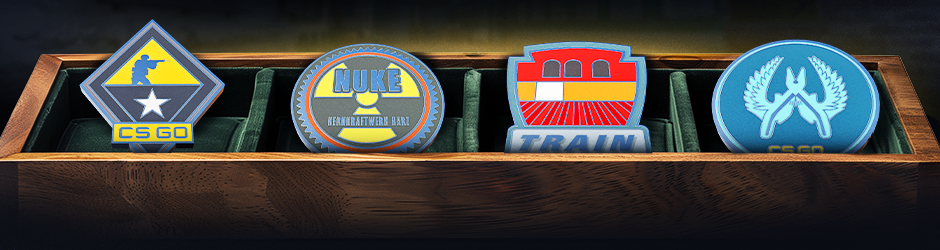
As the name suggests, Regular Pins are the standard digital format available to most players. You can unbox them from specific capsules purchased through the in-game store or straight from the Steam Community Market. Regular Pins are fully marketable and tradable, meaning you can buy, sell, or swap them freely.
However, keep the trade hold in mind. When you buy a capsule or a pin, you lock the item to your inventory for a week, thanks to Steam’s standard cooldown on new items.
Genuine Pins
Valve originally created these as actual, physical metal pins sold exclusively at Major tournaments. Along with the physical collectible, buyers received a special code to redeem a digital Genuine Pin in-game or through Steam. After a few years, though, Valve figured out that pushing purely digital copies pulled in way more profit. Because of this shift, everything changed in 2019.
Whether that shift was good or bad is up for debate, but one thing is certain: Genuine Pins are now incredibly rare and highly sought-after collectibles. Today, you can only grab a Genuine Pin by buying an unredeemed code from a third-party seller. Enter this market at your own risk, because scammers heavily target the code-selling scene. If you decide to hunt one down, thoroughly vet your seller and never trust random or unverified marketplaces.
It’s also worth noting how they look in your inventory. The game slaps a green “Genuine” rarity tag right in front of the item’s name, instantly separating these rare flexes from the standard versions of the exact same design.
CS2 Pin Series Overview
Thanks to the community’s great work tracking down info on pins, we can easily break it all down for you. Let’s dive into the different series and see what makes each one unique. Overall, Valve has released four official pin capsules – three main ones and a special edition dedicated to Half-Life: Alyx. Series 1, 2, and 3 each feature 11 pins split across different rarity tiers, while the Half-Life: Alyx collection has one extra pin.
Interestingly, data-miners have also uncovered info about a Series 4 that never actually saw the light of day – but we’ll cover that a bit later.
Series 1 — Collectible Pins Capsule Series 1
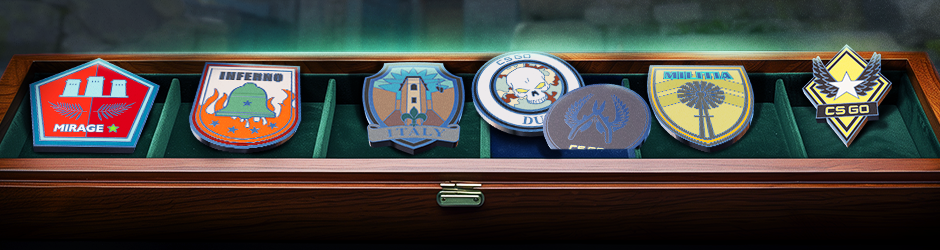
Let’s kick things off with the first capsule (or series, as most call it). Valve announced it on March 6, 2015, for ESL One Katowice 2015, where they originally sold the physical versions. The digital capsule hit the in-game store on June 1, 2016. All 11 designs were based on the iconic CS:GO maps in the active duty pool at the time.
- High Grade Collectible: Nuke, Train, Guardian, and Tactics. These are the most accessible pins in the series – super popular thanks to their recognizable designs and low entry price for new collectors.
- Remarkable Collectible: Victory, Italy, and Militia. Out of this trio, only the Victory Pin holds any real value and popularity. The other two just don’t see much market demand.
- Exotic Collectible: Mirage and Inferno. Both showcase the most iconic landmarks from their respective maps – the three towers on Mirage and the Inferno bell tower. They remain highly popular and hold a stable market price.
- Extraordinary Collectible: Guardian Elite and Dust II. These are the rarest and most expensive pins in the first series. Both feature a simple yet striking design, and the Dust II pin specifically remains one of the most sought-after items in the entire collection.
Let’s move on to the next series.
Series 2 — Collectible Pins Capsule Series 2
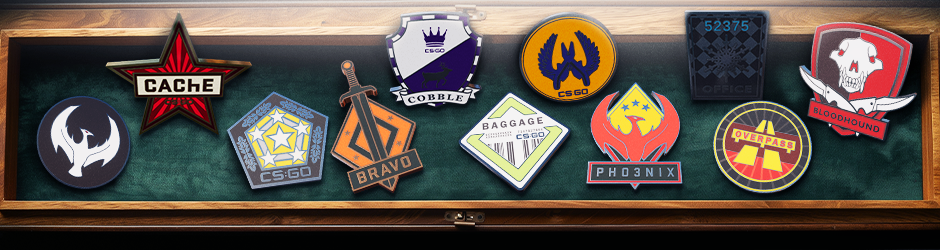
Valve spiced things up with the second series. For the first time, they introduced pins dedicated to CS:GO Operations rather than just focusing on maps. This change made the collection much more diverse and interesting for collectors.
- High Grade Collectible: Baggage, Guardian 2, Bravo, and Phoenix. In this rarity tier, Phoenix and Guardian 2 boast nice designs, though Guardian 2 is essentially just a recolored version of the original.
- Remarkable Collectible: Overpass, Cobblestone, and Office. You might have guessed it, but Overpass is the only really popular one in this group. Almost nobody searches for Cobblestone and Office anymore since Valve removed those maps from the active pool.
- Exotic Collectible: Cache and Bloodhound. Cache is definitely the community favorite here, mostly fueled by map nostalgia. Bloodhound features a unique shape that really makes it stand out from the rest of the series.
- Extraordinary Collectible: Chroma and Valeria Phoenix. Chroma holds the questionable honor of being the cheapest pin in the Very Rare category. It looks okay, but it lacks character. Valeria Phoenix is the exact opposite: it’s one of the most popular and expensive pins in the whole collection.
Series 3 — Collectible Pins Capsule Series 3
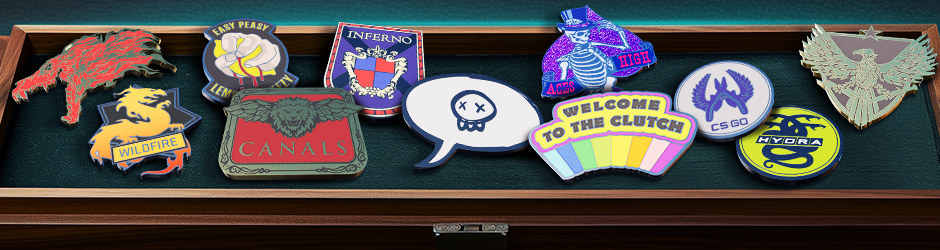
The third series dropped in March 2018 and became the most diverse one yet. Valve stepped away from strictly map-based designs and threw in pins inspired by Operations and iconic stickers.
- High Grade Collectible: Guardian 3, Canals, Welcome to the Clutch, and Death Sentence. These are the most accessible pins in the series, but Welcome to the Clutch definitely stands out. It runs slightly more expensive than the others in this group, thanks to the recognizable slogan.
- Remarkable Collectible: Wildfire, Easy Peasy, and Inferno 2. It’s hard to say any of these are wildly popular; they all see roughly the same market demand.
- Exotic Collectible: The Hydra pin pays tribute to Operation Hydra with a distinct snake-like design. Aces High – featuring a skeleton with ace cards tucked into its hat – is one of the most detailed pins in the entire collection and was incredibly popular right after the capsule dropped.
- Extraordinary Collectible: Brigadier General and Howl. What else is there to say? The crown jewel of this capsule is obviously the Howl, heavily inspired by the legendary M4A4 Howl skin.
Half-Life: Alyx Collectible Pins
Valve added this special series to the game just one day before releasing Half-Life: Alyx in March 2020. This is the only pin series that steps outside the Counter-Strike universe. It features pins dedicated to the Half-Life lore: Lambda, Vortigaunt, and Alyx. The Alyx pin sits at the top as the rarest and most desirable design in the set. Players who bought Valve Index hardware before the game’s release received a Genuine version of the Alyx Pin.
Series 4 — Announced But Never Released
As promised, here is a little bit of info about the fourth series that still isn’t in the game. In March 2023, data miners dug into the CS2 files and found info on Series 4, featuring 11 new pins: Guardian 4, Hello AK, Hop, Vertigo, Popdog, Riptide, Ancient, Shattered Web, Dust II 2, Boss, and Anubis.
The community expected the series to drop during the BLAST Paris Major 2023, but it never happened. As of April 2026, Valve still hasn’t made any official statements regarding Series 4. Whether it will ever actually come out remains a total mystery.
That wraps up the different series, but we still have a few other crucial details you shouldn’t miss.
CS2 Pin Rarity System
When it comes to pin rarity, the situation looks a lot like weapon skins. You open a capsule, and it drops anything from basic pins to much rarer ones. To be exact, pins fall into four different rarity tiers. We already mentioned them above when breaking down the contents of each collection.
Here is how those tiers break down:
- Common (High Grade): Just like with skins, this is the most frequent drop. You’ll easily pull these pins from a capsule, making them the cheapest to buy on the market. Prices vary, but they usually hover around $3 to $5 per pin.
- Uncommon (Remarkable): Think of this as the mid-tier. They drop slightly less often than Common pins. The price range usually sits between $5 and $10, occasionally bumping up to $12 depending on the specific design’s popularity.
- Rare (Exotic): You will have a noticeably harder time unboxing these. Market prices start anywhere from $5.00 to $20.00. This tier houses pins like Mirage, Inferno, Hydra, and Aces High.
- Very Rare (Extraordinary): This is the ultimate, top-tier rarity for Regular pins. They are incredibly difficult to unbox, making them the most desirable and expensive – for obvious reasons. This tier includes the absolute grails of the collection: Dust II, Guardian Elite, Howl, Valeria Phoenix, and Brigadier General, with prices starting from $30.00 to $40.00+.
We should also clarify the terminology. In-game, the pins use the labels High Grade, Remarkable, Exotic, and Extraordinary. However, the community traditionally refers to them as Common, Uncommon, Rare, and Very Rare, borrowing from the skin rarity system. Both versions mean the exact same thing.
To give you an example, Genuine pins don’t have their own standalone rarity tier. The game simply slaps the “Genuine” prefix onto the existing rarity. Ultimately, a Genuine Howl stays a Very Rare pin, but its unique account-bound status makes it far more valuable than the regular version of that same design.
Most Valuable CS2 Pins
Since we only have four pin sets, the market isn’t nearly as massive as the skin market. Still, certain pins really stand out. Some turn a solid profit as investment vehicles, while others just look incredibly cool on a player’s profile.
- Howl Pin (~$48.00–$67.00) Series 3 — Very Rare. Inspired by the legendary M4A4 Howl, this pin owes its rarity to the skin’s unique history. Of course, you can’t forget that it’s notoriously difficult to unbox thanks to those tiny drop odds.
- Valeria Phoenix Pin (~$48.00–$92.00) Series 2 — Very Rare. This pin grabs your attention purely through its design. The contrast of the white phoenix against the dark background looks incredibly clean and premium, making it a top-tier flex for your player profile!
- Guardian Elite Pin (~$38.00–$42.00) Series 1 — Very Rare. A simple yet bold design straight from the first pin series. As one of the earliest collectible pins in Counter-Strike history, it holds a special place in the hearts of community veterans.
- Alyx Pin (~$33.00–$40.00) Half-Life: Alyx Series — Very Rare. The rarest pin from the special Half-Life crossover series. The detailed artwork of the main character, combined with a limited market supply, keeps its price consistently high.
- Dust II Pin (~$32.00–$35.00) Series 1 — Very Rare. An iconic tribute to the most popular map in Counter-Strike history. It’s a clean, simple, and instantly recognizable design.
A quick heads-up on pricing: the pin market is way less liquid than the skin market, meaning prices can swing wildly across different third-party marketplaces. They tend to climb slowly, crash hard, and then slowly recover. If you’re seriously considering these as an investment, you need to think twice and do your homework.
How to Get CS2 Pins
If you’re wondering how to get CS2 pins, the answer is much simpler than it looks. You have a few different ways to score them, and each method suits a different budget and goal.
Unbox a Capsule
The most common way to get a Regular pin is, obviously, to buy and unbox one of the four official capsules. You generally have two ways to buy a capsule: directly through the in-game Store or over on the Steam Community Market. In practice, they accomplish the exact same thing.
Current capsule prices:
- Collectible Pins Capsule Series 1 — around $7.00–$12.00
- Collectible Pins Capsule Series 2 — around $5.00–$8.00
- Collectible Pins Capsule Series 3 — around $5.00–$6.00
- Half-Life: Alyx Collectible Pins Capsule — around $4.00–$6.00
But here is the dilemma: unboxing is always a total random. You might pull a $2.00 Common pin, or you might hit the jackpot with a $60.00+ Very Rare. So, does it make more sense to just buy the pin you want directly? That’s the real question.
Buy Directly from the Market
The absolute most efficient way to get the exact pin you want is to buy it directly from the Steam Community Market or trusted third-party marketplaces. This completely eliminates the capsule lottery and guarantees you get your desired design for a set market price. For most Regular pins, prices bottom out at $2.00–$3.00 for Commons and can spike all the way up to $90.00+ for the most elusive Very Rare grails.
You do have a third option: trying to buy a physical Genuine pin code somewhere online. However, these are notoriously ridden with scams, especially since Valve officially shut down physical sales back in 2019. Sure, it’s theoretically possible to find a legit code, but you’re better off avoiding that headache unless you want to risk losing your money.
Are CS2 Pins a Good Investment?
Honestly, the situation here is a bit of a mixed bag. Treating the capsules themselves as investments is generally a bad play. Nobody will buy a capsule from you at a markup when they can just purchase an unlimited supply directly from the in-game store. Will Valve ever stop selling them? That’s the real wild card.
If they pull them from the store, capsule prices will skyrocket. But no one knows if or when that will happen – just like nobody expected knife trade-ups from five Covert skins.
On the flip side, if you’re looking to invest in individual rare pins, things get much more interesting. Very Rare pins like the Howl, Valeria Phoenix, and Guardian Elite show a slow but steady price growth over time. This happens because the active supply naturally shrinks – collectors lock these pins away in their inventories as long-term holds and have zero intention of ever selling them.
The choice is always yours, but let’s move on.
How to Equip and Showcase Pins in CS2
The final question players usually have after buying or unboxing a pin is, “How do I actually equip this thing?” Again, it’s super simple. Let’s break it down step-by-step:
- Open the main CS2 menu.
- Click on your avatar or head over to your profile section.
- Find your display item slot – this is where your pin goes.
- Select the pin from your inventory and equip it.
To Sum Up
So, today we learned that CS2 pins carve out a truly unique niche within the Counter-Strike ecosystem. They bring their own history, a cool aesthetic, and a market price that steadily climbs over time. If you want a way to customize your profile while flexing something with a bit of character, pins get the job done perfectly – especially now that you know all the details!
If you want to dive deeper into the world of CS2 and learn more about its unique features, stick around!
FAQ
They display right next to your nickname on the scoreboards and on your player profile. They are purely cosmetic.
In short, it’s just like the situation with weapon skins: some are extremely rare, and some aren’t. Regular Common pins are highly accessible and cost anywhere from $2.00 to $5.00. Meanwhile, Very Rare pins only have a tiny 0.64% drop rate and can run you upwards of $90.00+.
Officially, no. Valve halted all physical sales after the Starladder Berlin Major back in September 2019. Today, your only real option is to buy an unused physical code from a third-party seller, which comes with a massive risk of getting scammed.
Among Regular pins, the Howl Pin and the Valeria Phoenix Pin are the rarest. Both sit at a brutal 0.64% drop rate and hit market prices of $90.00+.
Regular capsules make for terrible investments because they have an infinite market supply. However, Very Rare pins slowly but reliably climb in value over time – so technically, the answer is yes!


